
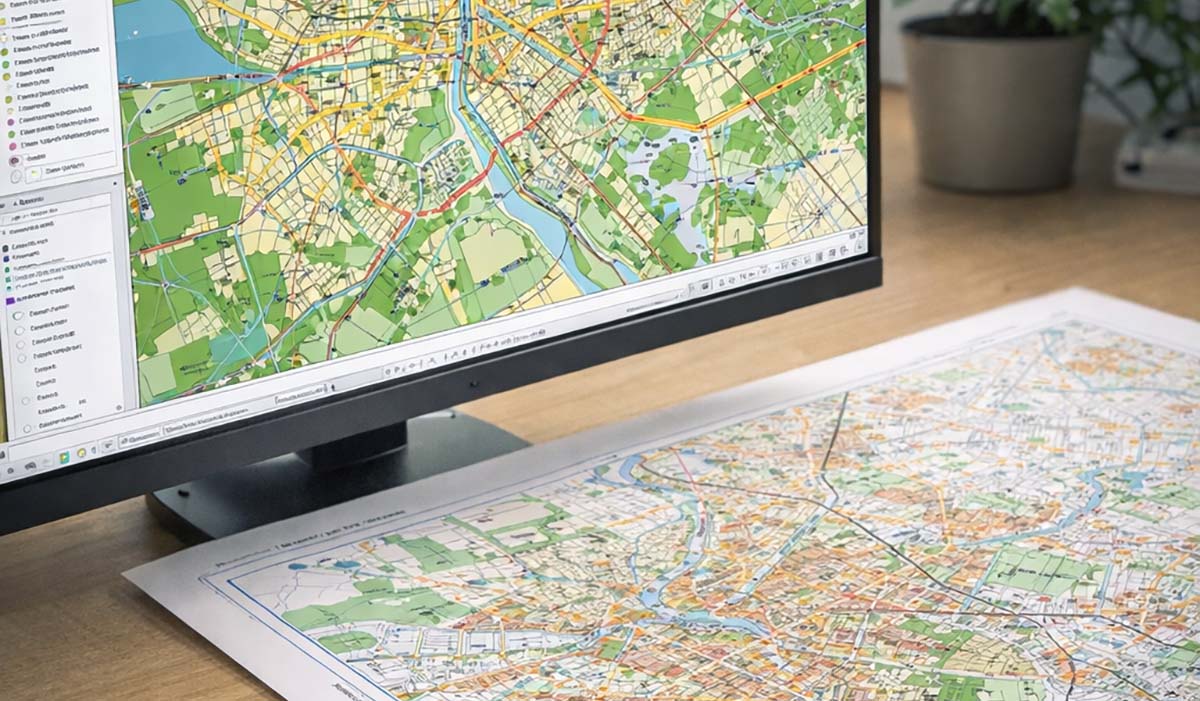
Why Clear Cartography Matters for Planning and Infrastructure Projects
In planning, infrastructure and policy work, complex spatial data is everywhere. Transport networks, development zones, environmental constraints, population statistics and land use information all need to be understood together. Without clear visualisation, this information quickly becomes difficult to interpret and communicate.
This is where professional cartography plays a critical role. Well-designed maps transform raw geographic data into clear visual information that supports analysis, communication and decision making.
For planners, consultants and public sector organisations, mapping is often the bridge between technical analysis and real-world understanding. Stakeholders, decision makers and the public all rely on maps to understand how projects affect places and communities. When mapping is poorly designed, important details can be misunderstood or overlooked.
Professional cartography focuses on clarity, hierarchy and accuracy. Elements such as colour selection, line weight, labelling and symbol design are carefully balanced so information can be read quickly without overwhelming the viewer. This ensures that key messages remain visible even when dealing with complex datasets.
Another important aspect of high-quality mapping is consistency. Planning and infrastructure projects often involve multiple reports, documents and presentations. Consistent mapping styles and symbols help audiences understand information across multiple outputs without confusion.
At Oxford Cartographers we work with organisations that need precise, data-driven cartography to support planning reports, infrastructure projects and research publications. Our approach ensures that spatial information is communicated clearly while maintaining the technical accuracy required by professional audiences.
As spatial datasets continue to grow in size and complexity, the need for well-designed cartography becomes even more important. Clear mapping not only improves communication but also helps organisations make better informed decisions.